
Beijing pollution in the 2010s was notoriously bad. I was only two when we moved there, but pollution management was a big part of my life. If pollution was above 180 AQI according to the American Embassy reading, there was no outdoor recess at school. This happened often. If we needed to go outside when the air was bad, we used N95 masks. I clearly remember jumping on the trampoline with my N95 on during one particularly long-lasting bad stretch. For me, mask wearing was so common that I had absolutely no problem with COVID requirements. I had been training for masking all day my whole life.
In January 2013, the “Airpocalypse” happened, and the pollution peaked at over 800 AQI, with one reading reaching 992. I was three and don’t remember it. We stayed inside with our air purifiers on high, and I’m sure it seemed like a totally normal day for me. I’m pretty sure I will always need a fan or white noise in my bedroom to help me sleep after years of having a large air purifier blasting on high 24/7.
People adapted. You stayed in. International schools installed massive air purification systems because it was a known issue in Beijing. Checking the AQI became part of daily life. My parents even tracked the wind, because if speeds were over 10 mph, it usually meant the pollution would clear.
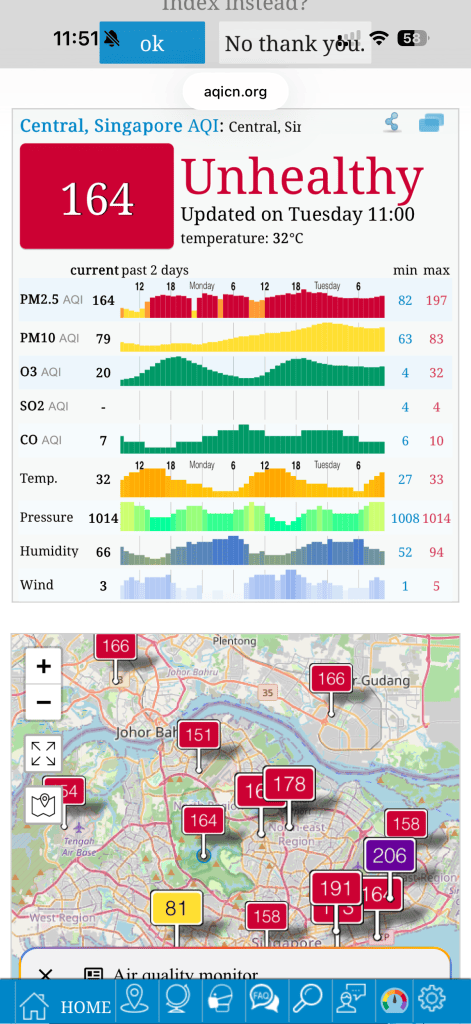
At the moment, we are experiencing pollution in Singapore due to smoke from forest and peat fires in Indonesia being carried across the region. It is nowhere near the extreme AQI we experienced in Beijing in 2013, but some pollution readings have climbed high enough to make the air noticeably bad. It is worse than in past years due to El Niño.
What has surprised me is how different it feels to experience bad air here. Air purifiers are not nearly as common. Singapore residents take advantage of our tropical outdoors often. Homes are usually not as tightly sealed because people like to open windows, air out their houses, and let them breathe. Pools, parks, outdoor restaurants, sports, and walking are a much bigger part of everyday life.
The gray sky feels familiar, but the way people live with it does not. In Beijing, pollution was a constant enough problem that much of our life was built around managing it. In Singapore, haze feels more like an interruption to a lifestyle where the outdoors is always available.
The pollution itself is different too. Beijing’s pollution was mostly connected to the city and region’s coal burning, factories, cars, construction, and rapid growth. Singapore’s haze can come from hundreds of miles away. Smoke crosses national borders, meaning the people breathing it are not necessarily the people who produced it.
Where pollution comes from changes how a city responds to it, and how often it happens changes how people adapt to it. The sky in Singapore right now reminds me of Beijing. Living it feels completely different.


Leave a comment